Showing posts with label Talent Crisis. Show all posts

Daily Tech Digest - October 26, 2026

Quote for the Day
“If you can’t describe what you are doing as a process, you don’t know what you’re doing.”
— W. Edwards Deming
Audio Edition — Listen to Today’s Digest
Narrated version of the Daily Tech Digest
Article Thumbnail

The Migration Succeeded. The System Got Worse

Moving an application to the public cloud is often seen as an automatic upgrade, but a successful migration does not always result in a better system. One of the most common mistakes is relocating an application while leaving its primary database in an on-premises data center. This separation introduces critical network delays, meaning a system that functions fine under normal traffic can quickly suffer from connection exhaustion and severe failures during peak demand. While the cloud offers useful capabilities like flexible capacity and managed services, these benefits only matter if the entire technology stack is optimized for them. Simply moving infrastructure without addressing underlying dependencies often leads to inflated costs and new operational risks. A hybrid approach can be effective if planned deliberately, but it becomes an expensive burden when components are separated without a clear strategy. Ultimately, there is no single correct environment for every workload. Deciding whether to migrate, maintain a hybrid setup, or bring systems back in-house requires a realistic evaluation of performance, dependencies, and true operating costs.

Read Original Article →

Healthcare Data Governance: Who Decides What Gets Used?

Healthcare data governance is much more than just creating internal rules; it requires assigning clear, enforceable decision rights as patient information moves across different systems, APIs, and AI models. Rather than simply asking who owns the data, organizations should divide authority into four specific areas: legal permissions, operational approval, technical enforcement, and final accountability. This division is vital because when data is shared with payers, cloud vendors, or secondary AI tools, the original privacy policies are easily lost if someone is not explicitly responsible for enforcing them. Crucially, moving data to a cloud environment does not remove the healthcare organization's ultimate accountability. To prevent confusion and maintain compliance, organizations need a simple decision-rights matrix that clearly names the single person responsible for defining, accessing, reusing, correcting, and deleting data at every step of its journey. Ambiguity between different departments often leads to failure. Therefore, every single data handoff must have a clear owner equipped with both the responsibility and the actual power to enforce policies and correct issues.

Read Original Article →
Article Thumbnail

Identity at checkout: why payments must prove more and share less

As digital identity tools and payment systems continue to merge, payment providers face new challenges regarding customer verification and data privacy. With the European Union requiring digital identity wallets by late 2026, the traditional multi-step checkout process is shifting into a single, unified action. However, this connection risks exposing too much personal information. To protect consumer privacy and avoid the high costs of financial data breaches, payment networks must ask for only the minimum details required to approve a transaction, rather than viewing a user's entire background. At the same time, updated European rules are shifting fraud liability directly onto payment providers. If weak security checks let fraud slip through, companies will face significant financial losses through mandatory customer refunds. Over the next two years, providers need to build checkout experiences that focus on strong but easy verification. By asking for less personal data while proving identity more securely, companies can lower their financial risks and build better trust with both merchants and everyday consumers.

Read Original Article →

India’s cybersecurity talent challenge: Why more automation must be matched by better skills

As artificial intelligence takes over routine cybersecurity tasks like filtering alerts, the role of security professionals in India is fundamentally changing. Instead of simply operating tools, experts must now focus on validating AI findings, making complex judgment calls, and understanding when an automated system might be wrong. A recent report shows that most Indian enterprises struggle to find candidates with these practical, hands-on skills. To bridge this gap, organizations need to rethink how they train their teams. Standard certifications are no longer enough. Instead, companies should offer role-specific training and simulated scenarios where professionals can practice handling incomplete information and testing automated security boundaries. This shift is a major opportunity for India’s technology sector to build a workforce capable of supporting global security operations. Ultimately, the future of cybersecurity isn't just about how much we can automate, but how well humans and machines can work together to defend an increasingly complex digital landscape.

Read Original Article →
Article Thumbnail

Psychological Safety: The Overlooked Risk in Workplace AI Adoption

As organizations integrate AI into daily operations, they heavily focus on data security and privacy while frequently overlooking a crucial human element: psychological safety. Employees are adjusting rapidly to these tools, which naturally creates anxiety about job security and personal competence. If workers feel afraid to admit they do not understand a system, or remain hesitant to challenge an odd result, small mistakes can easily go unnoticed and escalate. A written corporate policy alone cannot prevent this. To use AI responsibly, leaders must actively build a workplace where people feel completely safe raising concerns. Management should encourage questions, acknowledge their own uncertainties, and demonstrate that healthy skepticism toward AI outputs is a sign of good judgment, rather than resistance to change. When leaders communicate clear expectations and actively support their teams, employees gain the confidence needed to catch errors early. Ultimately, building trust ensures that these new tools are used responsibly and effectively as a normal part of everyday work.

Read Original Article →
Article Thumbnail

Your AI Agent Has a Supervisor. Are They Qualified?

As AI systems handle more tasks in security operations, they are not replacing human analysts. Instead, analysts are shifting into supervisory roles to direct and review the technology's work. The central issue is that many companies simply add this responsibility to an analyst's existing workload without providing proper training, clear guidelines, or a defined job title. To fix this, organizations must establish AI supervision as a distinct and formal role. Supervisors need a deep understanding of security threats so they can properly set limits, question the AI's reasoning, and catch missing evidence. A supervisor's readiness should be tested through practical exercises rather than basic training completion. When evaluating success, security teams should focus on the quality of these reviews instead of how quickly tickets are closed. As AI tools gain the ability to take direct actions, like isolating systems or disabling accounts, strict human oversight becomes increasingly vital. Ultimately, a qualified human supervisor must own the final decisions to ensure accountability and maintain a secure environment.

Read Original Article →

Enterprise Deployment Architecture for Agentic AI on IIS: ChatGPT-Style UI over Agents & MCP Servers

The article outlines an architectural guide for deploying a ChatGPT-style web interface using Microsoft Internet Information Services (IIS) to front an agent powered by the Model Context Protocol (MCP). Instead of running agent interactions in a basic developer console, the paper presents a system tailored for enterprise needs, supporting 25 to 30 concurrent users. It relies on Windows Authentication and an IIS reverse proxy connecting to a long-running Python service. This design choice provides stability and avoids the overhead of launching a new process for every user request, while also eliminating the need for complex Kerberos double-hop delegation. The reference model, named ChefAI, illustrates a practical use case where restaurant staff query an assistant for real-time information, invoice generation, and technical troubleshooting. The agent connects to a local server for secure local tasks and remote HTTP servers for retrieving documents or analyzing logs. By using Server-Sent Events, the setup ensures smooth progress streaming to the chat interface, keeping the user interface completely independent of how the underlying tools are accessed or deployed.

Read Original Article →
Article Thumbnail

Your PQC Plan Trusts the One Thing You May Not Be Checking

As organizations prepare for post-quantum cryptography, they usually focus on mapping their current encryption tools and ensuring software flexibility. However, many migration plans overlook a critical, foundational vulnerability: the quality of their random number generators. Even the most advanced encryption algorithms will fail if the underlying randomness is predictable or generated by flawed hardware. Rather than relying solely on software upgrades, companies must trace exactly where their randomness originates and ensure it comes from verified, properly functioning sources. Upgrading safely requires identifying outdated legacy systems that cannot support new standards and adjusting procurement policies to demand quantum-resistant features immediately. Security leaders should treat this transition as a vital business continuity effort, not just an IT compliance checklist. By securing hardware-level trust, verifying random number generation, and acting early, organizations can effectively protect their most critical systems and avoid the steep financial costs of rushing to fix vulnerabilities later.

Read Original Article →
Article Thumbnail

Java vs Python in 2026: Which One Should You Learn for Backend, AI, and Data Science?

In 2026, the choice between Java and Python depends on your engineering goals rather than which language is simply more popular. Python is the primary language for artificial intelligence, machine learning, and data analytics. Its extensive ecosystem makes it the standard for researching and training models. On the other hand, Java remains the foundation for large enterprise backend systems, such as banking and retail platforms. Java provides the performance, structural safety, and mature frameworks needed to support massive, high-traffic codebases over many years. In practice, companies often use both: Python builds the AI models, while Java runs the reliable infrastructure around them. Python has an easier learning curve and gets you building faster, whereas Java requires more initial effort but teaches strict engineering fundamentals. Ultimately, if you aim to work directly with data or machine learning, start with Python. If you prefer building durable, large-scale backend architecture, focus on Java. Both offer strong career paths without the need for hype.

Read Original Article →

What Is CRQ? Cyber Risk Quantification Guide

Cyber risk quantification is a method that assigns clear financial values to potential security threats, allowing organizations to understand the real-world business impact of cyber events. Rather than viewing security solely as a technical issue, this approach translates risks into standard financial terms, making it much easier for security leaders to communicate with corporate boards and executives. By analyzing historical data alongside the frequency and severity of potential incidents, organizations can predict financial losses across both internal systems and third-party providers. This clarity helps businesses move away from subjective guesswork, enabling them to make practical decisions about where to invest their security budgets and how to prioritize protective measures. In addition to improving internal planning, putting a dollar figure on risk helps organizations negotiate better insurance terms, measure the return on their security investments, and establish a realistic tolerance for risk. Ultimately, calculating these financial impacts provides companies with the necessary insight to reduce the overall cost of security incidents and maintain steady operations.

Read Original Article →

Daily Tech Digest - September 07, 2026


Quote for the day:

"To succeed, high integrity must precede high ambition or high performance. Always do the right thing for the right reasons." -- Vala Afshar

🎧 Listen to the audio debrief on YouTube

▶ Play Audio Digest

Duration: 21 mins • Perfect for listening on the go.


Your AI Productivity Gains Are Creating a Talent Crisis

As companies aggressively adopt artificial intelligence to handle routine tasks, they are inadvertently creating a hidden talent crisis for the future. While automating foundational work provides immediate efficiency and saves valuable time, it quietly dismantles the traditional apprenticeship model that young employees rely on to build expertise. Historically, doing repetitive tasks allowed junior professionals to develop the critical judgment and pattern recognition required to eventually become senior experts. This dynamic leads to a senior worker paradox. Current experienced professionals can effectively guide and evaluate artificial intelligence because they built their underlying knowledge before these tools ever existed. However, the next generation of workers is expected to supervise complex systems without gaining that identical practical experience. Consequently, organizations are accumulating a serious capability debt, where high daily output masks a growing inability among staff to solve problems independently without technological assistance. To prevent this looming skill shortage, businesses need to rethink how they implement these systems. Instead of using artificial intelligence merely as an engine to generate quick answers, companies should deploy it as a supportive coach. By designing workflows where the technology challenges assumptions, critiques reasoning, and highlights weaknesses without simply correcting them, organizations can help employees develop essential independent judgment.


Data Is Risky Business: Thinking Beyond Systems for Data Governance

Data governance goes far beyond formal frameworks, organizational charts, and written policies. While audits can evaluate a system by its final outputs, they rarely explain why well-intentioned employees within well-designed structures fail to govern data effectively. The true practice of data governance is shaped continuously by how people interpret their roles and responsibilities in everyday situations. Employees often rely on inherited traditions and beliefs when faced with real-world dilemmas, meaning that a formal rule is less influential than what the employee believes the rule is actually for. A documented procedure or escalation process only works if team members feel comfortable using it and believe that flagging an issue demonstrates competence rather than causes trouble. Effective coordination among teams, where individuals understand how their actions affect the wider organization, is crucial for catching anomalies and handling unexpected disruptions. Furthermore, over-automating these governance processes can be dangerous. When human reviewers are removed from routine tasks, they lose the practical experience needed to spot complex or novel failures when automation inevitably falls short. Ultimately, resilient data governance requires organizations to intentionally cultivate a culture of collaboration, build strong communication routines, and maintain the critical human judgment needed to handle unpredictable data risks.


The BTABoK and Agents

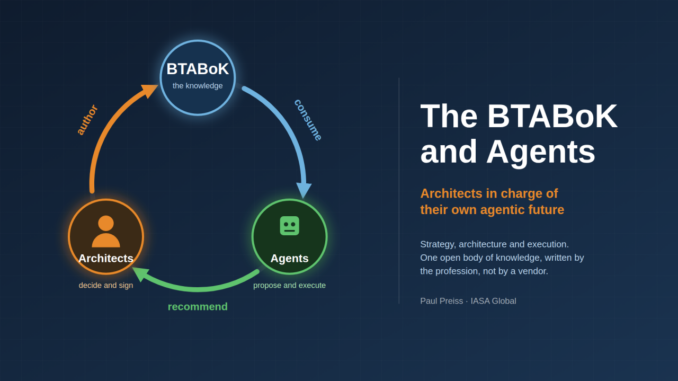
Artificial intelligence agents can generate impressive architectural models in seconds, but their output is only as good as the knowledge they draw from. While agents make speed cheap, they can compromise decision quality and shared understanding if not set up correctly. The Business Technology Architecture Body of Knowledge offers the most effective foundation for integrating agents into technology architecture. Unlike vendor specific frameworks that prioritize product sales or in house wikis that rely on fragmented opinions, this open framework provides a continuous chain connecting strategy to final delivery. It treats decisions as the central artifacts, ensuring every choice has clear trade offs and an accountable human owner. This is crucial because an agent produces options too quickly for humans to review without structured decision records. Furthermore, the framework defines specific viewpoints to answer exact stakeholder concerns and includes a clear competency model, meaning human architects remain equipped to properly evaluate and approve the generated work. Ultimately, this approach ensures that human practitioners, rather than vendors, remain in charge of the knowledge their agents use. By relying on a structured and practitioner governed foundation, organizations can safely accelerate their architecture practices without sacrificing accountability or quality.


Why Cybersecurity Must Become A Truly Professionalised Industry

The cybersecurity industry handles incredibly sensitive data and systems, bearing a level of responsibility similar to the medical or financial fields. However, it still lacks the strict, universal professional standards found in those established sectors. Currently, the quality of services like penetration testing varies significantly between providers, making it difficult for organizations to distinguish true expertise from clever marketing. To build genuine trust, the industry must adopt independent accreditation and verified certifications for both organizations and individual practitioners. Frameworks like the United Kingdom's CHECK scheme or global bodies like CREST offer a reliable baseline, assessing not just technical skills but also ethical conduct and operational maturity. As artificial intelligence makes sophisticated attack tools much more accessible, relying on validated human judgment becomes even more essential. Furthermore, because technology evolves rapidly, professionals must undergo continuous reassessment rather than relying on static, one-time qualifications. Professionalizing cybersecurity is not about adding unnecessary bureaucracy; it is about ensuring accountability, reliability, and consistency across the board. By demanding rigorous, ongoing standards, organizations can confidently partner with security experts, knowing they possess the necessary skills and ethics to protect vital digital infrastructure from increasingly complex and fast-moving threats.


Behind every AI inferencing strategy: The storage decision multi-model databases demand

As businesses rapidly deploy generative AI, the focus is shifting from simply training models to the critical phase of inferencing—the point where AI actually analyzes data and generates responses. While powerful processors like GPUs often grab the headlines, the true bottleneck for successful AI inferencing usually lies in data storage. Modern AI applications do not just rely on one type of data; they require a complex mix of text, images, relationships, and structured information. This complexity has driven the rise of multi-model databases, which can handle various data types—such as graphs, documents, and vectors—within a single system. However, these versatile databases place immense strain on storage infrastructure. To deliver the real-time, accurate results that enterprise AI demands, storage systems must provide exceptional speed, massive scalability, and the ability to process multiple data formats simultaneously without latency. Traditional, siloed storage setups often struggle to keep pace with these multi-model demands. Therefore, organizations must carefully evaluate their storage architecture, prioritizing high-performance solutions that seamlessly support multi-model databases. Ultimately, a successful AI strategy depends just as much on selecting the right underlying storage as it does on choosing the most advanced algorithms or processors.


Inside a Software Factory

The concept of a software factory is evolving from a traditional managed pipeline into an automation-driven system that transforms how engineering teams build and ship code. Instead of relying solely on artificial intelligence as a simple coding assistant within an editor, a modern software factory integrates automated agents directly into the broader development lifecycle. This system requires four core properties: standardized inputs, standardized tooling, measurable outputs, and complete replayability. Work enters the factory through various signals like bug reports or internal requests, which are then triaged into clearly scoped tasks. From there, software development agents take over to plan, execute, test, and review the code changes. However, humans remain firmly in the loop. The architecture relies heavily on persistent context, ensuring that security policies, business rules, and architectural guidelines govern the automated actions at every step. This shifts the role of software engineers. Rather than writing every line of code themselves, engineers now manage and supervise the underlying system, taking responsibility for its safety, governance, and business outcomes. Ultimately, this approach creates a continuous feedback loop where the development environment learns and improves over time, enabling organizations to deliver reliable software with greater consistency and visibility.


Leverage Code Review for Sustainable AI Coding Development

As artificial intelligence tools become a standard part of the software development process, teams are generating code at an unprecedented pace. While these advanced assistants significantly boost immediate productivity, they also introduce unique challenges. Without proper oversight, automated code can easily hide subtle bugs, security vulnerabilities, and structural flaws that ultimately create massive technical debt. To build applications responsibly, organizations must leverage rigorous code review practices to ensure lasting sustainability. Instead of blindly accepting computer suggestions, engineering teams must adapt their review processes to carefully scrutinize artificial intelligence contributions. Human oversight remains absolutely essential in this new landscape. Developers need to act as diligent editors, thoroughly validating the logic, performance, and security of every generated block of code before it reaches production. Strong peer review cultures prevent quick fixes from becoming massive maintenance nightmares. Furthermore, combining human expertise with modern testing tools ensures that codebases remain clean, functional, and secure over time. By placing a renewed emphasis on thorough code reviews, companies can safely harness the incredible speed of modern development tools. This balanced approach allows teams to innovate rapidly while maintaining the high standards required for sustainable and reliable software architecture today.


Why agentic AI is the key to systems integrity

As companies face stricter operational and security regulations, they are rapidly adopting agentic artificial intelligence systems capable of taking actions autonomously with minimal human input. While these powerful tools offer substantial productivity boosts, they also require broad data access and elevated privileges to function properly. This greatly expands the attack surface and introduces new vulnerabilities, especially within heavily regulated industries. Balancing this rapid innovation with strict oversight is a major challenge, particularly when organizations attempt to scale advanced tools across older, fragmented technologies. The most effective solution lies in deploying enterprise-grade platforms that embed security controls directly into their core design from the very beginning. By weaving identity management, access limitations, and continuous monitoring directly into the software development process, well-designed agentic systems actually strengthen overall integrity rather than weaken it. This proactive approach standardizes workflows, enforces real-time policy compliance, and prevents unauthorized internal development. To successfully scale these intelligent operations, businesses must unify their technology platforms, integrate security measures much earlier in the planning stages, and provide automated guardrails that empower teams to explore safely. Ultimately, treating oversight as a fundamental building block ensures that organizations can embrace modern automation without sacrificing valuable customer trust or compromising critical internal data.


From data residency to tech sovereignty: Europe rethinks control

European governments are moving past simply storing sensitive data within their borders and are now deeply questioning who truly controls their digital infrastructure. High-profile actions, such as Switzerland avoiding American cloud services for its national digital identity system and the Netherlands blocking a U.S. acquisition of a critical local cloud provider, highlight a growing concern over digital sovereignty. The core issue lies in jurisdiction: even if data is stored in a European server and heavily encrypted, relying on foreign-owned companies means the information might still be subject to outside laws, like the U.S. CLOUD Act. To counter these vulnerabilities, Europe is expanding its definition of tech sovereignty far beyond mere data localization. The European Commission has introduced strict new frameworks for cloud procurement that evaluate strategic, legal, and operational control, sometimes requiring an entirely European supply chain. Furthermore, the push for digital autonomy includes developing independent capabilities in semiconductors, artificial intelligence, and biometrics to reduce reliance on foreign standards and institutions. By prioritizing decentralization in projects like digital identity wallets, Europe aims to minimize centralized data storage altogether, asserting true control over its entire technology ecosystem rather than just dictating where its data physically resides.


Automated response and SOAR design patterns for security teams

Security Orchestration, Automation, and Response (SOAR) functions as an essential control layer that connects various security tools and teams, transforming noisy alerts into consistent, repeatable workflows. Rather than replacing human judgment or detection engineering, SOAR platforms excel at tasks like alert enrichment, case creation, and careful incident containment. A fundamental design principle for safe automation is separating decision support from direct execution. Playbooks should gather vital context and recommend actions, but automated responses must always align closely with technical confidence levels and potential business impact. If underlying detection quality is poor, reckless automation will simply accelerate bad decisions and disrupt daily operations. For many organizations, particularly smaller enterprises, the safest and most valuable initial pattern is automated alert triage and data enrichment. This approach rapidly improves decision quality without introducing unnecessary operational risk. When teams do choose to automate containment actions, such as isolating a compromised endpoint or forcing a user password reset, these interventions should strictly apply to high-confidence, reversible scenarios. Identity-focused responses often provide the cleanest automation targets because they remain centralized and are easily reversed if necessary. Ultimately, successful automation must carefully follow reliable detection quality instead of attempting to forcibly solve ambiguous security threats.