Quote for the day:
"No person can be a great leader unless he takes genuine joy in the successes of those under him." -- W. A. Nance
🎧 Listen to this digest on YouTube Music
▶ Play Audio DigestDuration: 22 mins • Perfect for listening on the go.
The agent security mess
 The article "The Agent Security Mess" by Matt Asay highlights a critical
vulnerability in enterprise security: the "persistent weak layer" of
over-provisioned permissions. Historically, security risks remained dormant
because humans typically ignore 96% of their granted access rights. However,
the rise of AI agents changes this dynamic entirely. Unlike humans, who act as
a natural governor on permission sprawl, autonomous agents inherit the full
permission surface of the accounts they use. This turns latent permission debt
into immediate operational risk, as agents can rapidly execute broad,
potentially destructive actions across various systems without the hesitation
or distraction characteristic of human users. To address this looming
"avalanche," Asay argues for a shift in software architecture. Instead of
allowing agents to inherit broad employee accounts, organizations must
implement purpose-built identities with aggressively minimal, read-only
permissions by default. This involves decoupling the ability to draft actions
from the ability to execute them and ensuring every automated action is logged
and reversible. Ultimately, AI agents are not creating a new crisis but are
exposing a long-ignored authorization problem, forcing the industry to finally
prioritize robust identity security and governance.
The article "The Agent Security Mess" by Matt Asay highlights a critical
vulnerability in enterprise security: the "persistent weak layer" of
over-provisioned permissions. Historically, security risks remained dormant
because humans typically ignore 96% of their granted access rights. However,
the rise of AI agents changes this dynamic entirely. Unlike humans, who act as
a natural governor on permission sprawl, autonomous agents inherit the full
permission surface of the accounts they use. This turns latent permission debt
into immediate operational risk, as agents can rapidly execute broad,
potentially destructive actions across various systems without the hesitation
or distraction characteristic of human users. To address this looming
"avalanche," Asay argues for a shift in software architecture. Instead of
allowing agents to inherit broad employee accounts, organizations must
implement purpose-built identities with aggressively minimal, read-only
permissions by default. This involves decoupling the ability to draft actions
from the ability to execute them and ensuring every automated action is logged
and reversible. Ultimately, AI agents are not creating a new crisis but are
exposing a long-ignored authorization problem, forcing the industry to finally
prioritize robust identity security and governance.Faster attacks and ‘recovery denial’ ransomware reshape threat landscape
 The CSO Online article, based on Mandiant’s M-Trends 2026 report, highlights a
dramatic shift in the cybersecurity landscape where ransomware attacks are
becoming both faster and more strategically focused on "recovery denial." A
striking finding is the collapse of the "hand-off" window between initial
access and secondary threat group activity, which plummeted from over eight
hours in 2022 to a mere 22 seconds in 2025. This acceleration is coupled with
a transition in tactics; voice phishing has overtaken email phishing as a
primary infection vector, signaling a move toward real-time, interactive
social engineering. Furthermore, attackers are increasingly targeting core
infrastructure, such as backup environments, identity systems, and
virtualization platforms, to systematically dismantle an organization’s
ability to restore operations without paying a ransom. Despite these rapid
execution phases, median dwell times have paradoxically risen to 14 days, as
nation-state actors prioritize long-term persistence alongside financially
motivated groups seeking immediate impact. These evolving threats necessitate
a fundamental rethink of defense strategies, urging organizations to treat
their recovery assets as critical control planes that require the same level
of protection as the primary network itself to ensure true resilience.
The CSO Online article, based on Mandiant’s M-Trends 2026 report, highlights a
dramatic shift in the cybersecurity landscape where ransomware attacks are
becoming both faster and more strategically focused on "recovery denial." A
striking finding is the collapse of the "hand-off" window between initial
access and secondary threat group activity, which plummeted from over eight
hours in 2022 to a mere 22 seconds in 2025. This acceleration is coupled with
a transition in tactics; voice phishing has overtaken email phishing as a
primary infection vector, signaling a move toward real-time, interactive
social engineering. Furthermore, attackers are increasingly targeting core
infrastructure, such as backup environments, identity systems, and
virtualization platforms, to systematically dismantle an organization’s
ability to restore operations without paying a ransom. Despite these rapid
execution phases, median dwell times have paradoxically risen to 14 days, as
nation-state actors prioritize long-term persistence alongside financially
motivated groups seeking immediate impact. These evolving threats necessitate
a fundamental rethink of defense strategies, urging organizations to treat
their recovery assets as critical control planes that require the same level
of protection as the primary network itself to ensure true resilience.Attackers are handing off access in 22 seconds, Mandiant finds
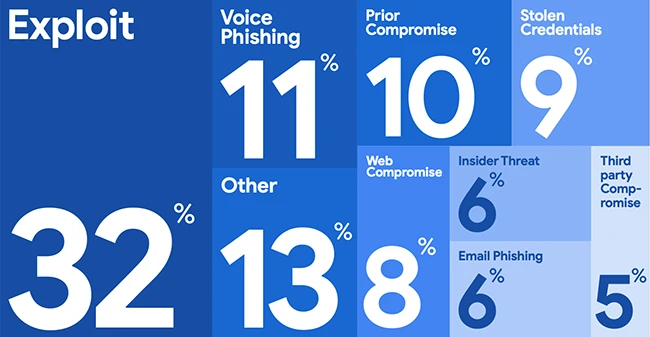 The Mandiant M-Trends 2026 report, based on over 500,000 hours of incident
response data from 2025, highlights a dramatic acceleration in attacker
efficiency and a significant shift in tactical focus. For the sixth
consecutive year, exploits remained the primary infection vector, yet the most
striking finding is the collapse of the "access hand-off" window; the median
time between initial compromise and transfer to secondary threat groups
plummeted from eight hours in 2022 to a mere 22 seconds in 2025. While overall
global median dwell time rose to 14 days—largely due to prolonged espionage
operations—adversaries are increasingly bypassing traditional defenses by
targeting virtualization infrastructure and backup systems to ensure "recovery
deadlock" during extortion. The report also identifies a surge in highly
interactive voice phishing, which has overtaken email as the top vector for
cloud-related compromises. Furthermore, while AI is being incrementally
integrated into reconnaissance and social engineering, Mandiant emphasizes
that the majority of breaches still result from fundamental systemic failures.
These evolving threats, including persistent backdoors with dwell times
exceeding a year, underscore the urgent need for organizations to modernize
their log retention policies and prioritize the security of their "Tier-0"
identity and virtualization assets.
The Mandiant M-Trends 2026 report, based on over 500,000 hours of incident
response data from 2025, highlights a dramatic acceleration in attacker
efficiency and a significant shift in tactical focus. For the sixth
consecutive year, exploits remained the primary infection vector, yet the most
striking finding is the collapse of the "access hand-off" window; the median
time between initial compromise and transfer to secondary threat groups
plummeted from eight hours in 2022 to a mere 22 seconds in 2025. While overall
global median dwell time rose to 14 days—largely due to prolonged espionage
operations—adversaries are increasingly bypassing traditional defenses by
targeting virtualization infrastructure and backup systems to ensure "recovery
deadlock" during extortion. The report also identifies a surge in highly
interactive voice phishing, which has overtaken email as the top vector for
cloud-related compromises. Furthermore, while AI is being incrementally
integrated into reconnaissance and social engineering, Mandiant emphasizes
that the majority of breaches still result from fundamental systemic failures.
These evolving threats, including persistent backdoors with dwell times
exceeding a year, underscore the urgent need for organizations to modernize
their log retention policies and prioritize the security of their "Tier-0"
identity and virtualization assets.From fragmentation to focus: Can one security framework simplify compliance?
In "From Fragmentation to Focus," Sam Peters explores the escalating
complexities of the modern cybersecurity landscape, driven by geopolitical
instability and a rapidly expanding attack surface. As digital transformation
progresses, businesses face a "messy" regulatory environment characterized by
overlapping requirements like GDPR, NIS 2, and DORA. This fragmentation often
leads to duplicated efforts, increased costs, and significant compliance
fatigue for organizations of all sizes. To combat these challenges, the
article positions ISO 27001 as a unifying "gold standard" framework. By
adopting this internationally recognized standard, companies can transition
from reactive defense to proactive risk management. ISO 27001 offers a
flexible, risk-based approach that can be seamlessly mapped to various global
regulations, thereby streamlining operations and reducing overhead. The
article argues that a consolidated security strategy does more than ensure
compliance; it fosters a security-first culture, builds digital trust, and
serves as a critical driver for competitive advantage and long-term business
resilience. Ultimately, moving toward a single, structured framework allows
leaders to navigate uncertainty with greater confidence, transforming security
from a burdensome cost center into a strategic asset that supports sustainable
growth in an increasingly volatile global market.
Microservices Without Drama: Practical Patterns That Work
 The article "Microservices Without Drama: Practical Patterns That Work" offers
a pragmatic roadmap for implementing microservices without succumbing to
architectural complexity. It emphasizes that while microservices enable
independent team movement, they should only be adopted when data boundaries
are crisp to avoid the "distributed monolith" trap. A core principle is
absolute data ownership, where each service manages its own dataset, accessed
via stable, versioned contracts using OpenAPI or AsyncAPI. The author
advocates for a balanced communication strategy, favoring synchronous calls
for immediate reads and asynchronous events for decoupled integrations.
Operational success relies on "boring fundamentals" like standardized
Kubernetes deployments, GitOps for configuration, and robust observability
through OpenTelemetry and Prometheus. Reliability is further bolstered by
defensive patterns, including circuit breakers, retries, and idempotency,
ensuring the system remains resilient during failures. Security is addressed
through mTLS and strict secrets management, moving beyond fragile IP-based
allowlists. Ultimately, the piece argues that microservices provide true
freedom only when teams invest in consistent standards and treat interfaces as
public infrastructure. By prioritizing data integrity and operational
repeatability over architectural trends, organizations can reap the benefits
of scalability without the associated drama of unmanaged complexity.
The article "Microservices Without Drama: Practical Patterns That Work" offers
a pragmatic roadmap for implementing microservices without succumbing to
architectural complexity. It emphasizes that while microservices enable
independent team movement, they should only be adopted when data boundaries
are crisp to avoid the "distributed monolith" trap. A core principle is
absolute data ownership, where each service manages its own dataset, accessed
via stable, versioned contracts using OpenAPI or AsyncAPI. The author
advocates for a balanced communication strategy, favoring synchronous calls
for immediate reads and asynchronous events for decoupled integrations.
Operational success relies on "boring fundamentals" like standardized
Kubernetes deployments, GitOps for configuration, and robust observability
through OpenTelemetry and Prometheus. Reliability is further bolstered by
defensive patterns, including circuit breakers, retries, and idempotency,
ensuring the system remains resilient during failures. Security is addressed
through mTLS and strict secrets management, moving beyond fragile IP-based
allowlists. Ultimately, the piece argues that microservices provide true
freedom only when teams invest in consistent standards and treat interfaces as
public infrastructure. By prioritizing data integrity and operational
repeatability over architectural trends, organizations can reap the benefits
of scalability without the associated drama of unmanaged complexity.The end of cloud-first: What compute everywhere actually looks like
 The article "The End of Cloud-First" explores a fundamental transition toward
a "compute-everywhere" architecture, where centralized cloud environments are
no longer the default destination for every workload. This evolution is driven
by the reality that the network is not a neutral substrate; bandwidth and
latency constraints, coupled with the explosion of IoT data, have made the
traditional cloud-first assumption increasingly untenable. The emerging model
operates across three distinct layers: a gateway layer for protocol
translation, an edge layer for localized processing near data sources, and a
centralized cloud layer reserved for heavy-lifting tasks like model training
and global analytics. Modern machine learning advancements now allow for
efficient inference on constrained devices, empowering local hardware to
filter and classify data autonomously rather than merely forwarding raw
telemetry. However, this decentralized approach introduces significant
operational complexity. IT leaders must now manage vast fleets of devices with
intermittent connectivity and navigate a landscape where partial system
failures are a normal steady state. Software updates become logistical
challenges rather than simple deployments. Ultimately, the focus is shifting
from simple cloud migration to sophisticated orchestration, ensuring that
intelligence and compute are placed precisely where they deliver value while
balancing performance, cost, and reliability.
The article "The End of Cloud-First" explores a fundamental transition toward
a "compute-everywhere" architecture, where centralized cloud environments are
no longer the default destination for every workload. This evolution is driven
by the reality that the network is not a neutral substrate; bandwidth and
latency constraints, coupled with the explosion of IoT data, have made the
traditional cloud-first assumption increasingly untenable. The emerging model
operates across three distinct layers: a gateway layer for protocol
translation, an edge layer for localized processing near data sources, and a
centralized cloud layer reserved for heavy-lifting tasks like model training
and global analytics. Modern machine learning advancements now allow for
efficient inference on constrained devices, empowering local hardware to
filter and classify data autonomously rather than merely forwarding raw
telemetry. However, this decentralized approach introduces significant
operational complexity. IT leaders must now manage vast fleets of devices with
intermittent connectivity and navigate a landscape where partial system
failures are a normal steady state. Software updates become logistical
challenges rather than simple deployments. Ultimately, the focus is shifting
from simple cloud migration to sophisticated orchestration, ensuring that
intelligence and compute are placed precisely where they deliver value while
balancing performance, cost, and reliability.
We’re fighting over GPUs and memory – but power manufacturing may decide who scales first
 In this article, Matt Coffel argues that while the global tech industry
remains fixated on GPU shortages and silicon supply chains, the true
bottleneck for scaling artificial intelligence lies in electrical
manufacturing capacity. As data center power demands are projected to surge
from 33 GW to 176 GW by 2035, the availability of critical infrastructure—such
as switchgear, transformers, and power distribution units—has become the
decisive factor in operational readiness. AI-intensive workloads demand
unprecedented power densities and constant uptime, yet the manufacturing
sector is currently struggling to keep pace with the rapid acceleration of AI
deployment. Traditional lead times of eighteen to twenty-four months clash
with the immediate needs of hyperscalers, exacerbated by a shortage of skilled
trades and over-customized engineering. To overcome these constraints, Coffel
suggests that operators must shift toward standardization, modularization, and
prefabricated power systems while engaging manufacturers much earlier in the
design process. Ultimately, the ability to scale will not be determined solely
by who possesses the most advanced chips, but by who can most efficiently
deploy the resilient electrical infrastructure required to keep those
processors running at scale.
In this article, Matt Coffel argues that while the global tech industry
remains fixated on GPU shortages and silicon supply chains, the true
bottleneck for scaling artificial intelligence lies in electrical
manufacturing capacity. As data center power demands are projected to surge
from 33 GW to 176 GW by 2035, the availability of critical infrastructure—such
as switchgear, transformers, and power distribution units—has become the
decisive factor in operational readiness. AI-intensive workloads demand
unprecedented power densities and constant uptime, yet the manufacturing
sector is currently struggling to keep pace with the rapid acceleration of AI
deployment. Traditional lead times of eighteen to twenty-four months clash
with the immediate needs of hyperscalers, exacerbated by a shortage of skilled
trades and over-customized engineering. To overcome these constraints, Coffel
suggests that operators must shift toward standardization, modularization, and
prefabricated power systems while engaging manufacturers much earlier in the
design process. Ultimately, the ability to scale will not be determined solely
by who possesses the most advanced chips, but by who can most efficiently
deploy the resilient electrical infrastructure required to keep those
processors running at scale.
Spec-Driven Development: The Key to Protecting AI-Generated Data Products
In "Spec-Driven Development: The Key to Protecting AI-Generated Data Products," Guy Adams explores the rising threat of semantic drift in the era of AI-accelerated data engineering. Semantic drift occurs when data metrics gradually lose their original meaning through successive updates, potentially leading to costly business errors when executives rely on inaccurate interpretations of "headcount" or other key figures. While traditional DataOps focuses on recording what was built, it often fails to document the underlying intent, a gap that AI-assisted development significantly widens. To counter this, Adams advocates for spec-driven development—a software engineering methodology that prioritizes clear, structured specifications before coding begins. By defining a data product’s purpose and constraints upfront, organizations can leverage agentic AI to audit every proposed change against the original requirements. This ensures that new implementations maintain coherence rather than undermining a product’s utility. Although maintaining manual specifications was historically cost-prohibitive, Adams argues that current AI capabilities make automated spec maintenance both feasible and essential. Ultimately, adopting this "left-shifted" documentation approach allows enterprises to build drift-proof data products that remain reliable even as AI agents accelerate the pace of development and modification across complex enterprise systems.IT Leaders Report Massive M&A Wave While Facing AI Readiness and Security Challenges
 According to a recent ShareGate survey published by CIO Influence, IT leaders
are navigating an unprecedented surge in mergers and acquisitions (M&A),
with 80% of respondents currently involved in or planning such events. This
massive wave, fueled by a 43% increase in global deal value during 2025, has
positioned M&A as a primary catalyst for IT modernization. However, this
acceleration brings significant hurdles, particularly regarding cybersecurity
and AI readiness. While 64% of organizations migrate to Microsoft 365
specifically to bolster security, 41% of leaders identify compliance and data
protection as top concerns during these transitions. The study also highlights a
shift in leadership; IT operations and security teams, rather than business
executives, are the primary drivers of AI adoption, such as Microsoft Copilot.
Despite 62% of organizations already deploying Copilot, they face substantial
blockers including poor data quality, complex governance, and access control
issues. Furthermore, 55% of teams select migration tools before fully assessing
integration risks, which can jeopardize long-term stability. Ultimately, the
report emphasizes that for M&A success, IT must evolve into a strategic
partner that integrates robust governance and security into the foundation of
every digital migration.
According to a recent ShareGate survey published by CIO Influence, IT leaders
are navigating an unprecedented surge in mergers and acquisitions (M&A),
with 80% of respondents currently involved in or planning such events. This
massive wave, fueled by a 43% increase in global deal value during 2025, has
positioned M&A as a primary catalyst for IT modernization. However, this
acceleration brings significant hurdles, particularly regarding cybersecurity
and AI readiness. While 64% of organizations migrate to Microsoft 365
specifically to bolster security, 41% of leaders identify compliance and data
protection as top concerns during these transitions. The study also highlights a
shift in leadership; IT operations and security teams, rather than business
executives, are the primary drivers of AI adoption, such as Microsoft Copilot.
Despite 62% of organizations already deploying Copilot, they face substantial
blockers including poor data quality, complex governance, and access control
issues. Furthermore, 55% of teams select migration tools before fully assessing
integration risks, which can jeopardize long-term stability. Ultimately, the
report emphasizes that for M&A success, IT must evolve into a strategic
partner that integrates robust governance and security into the foundation of
every digital migration.


No comments:
Post a Comment